Who doesn't want their parents to live to a hundred?
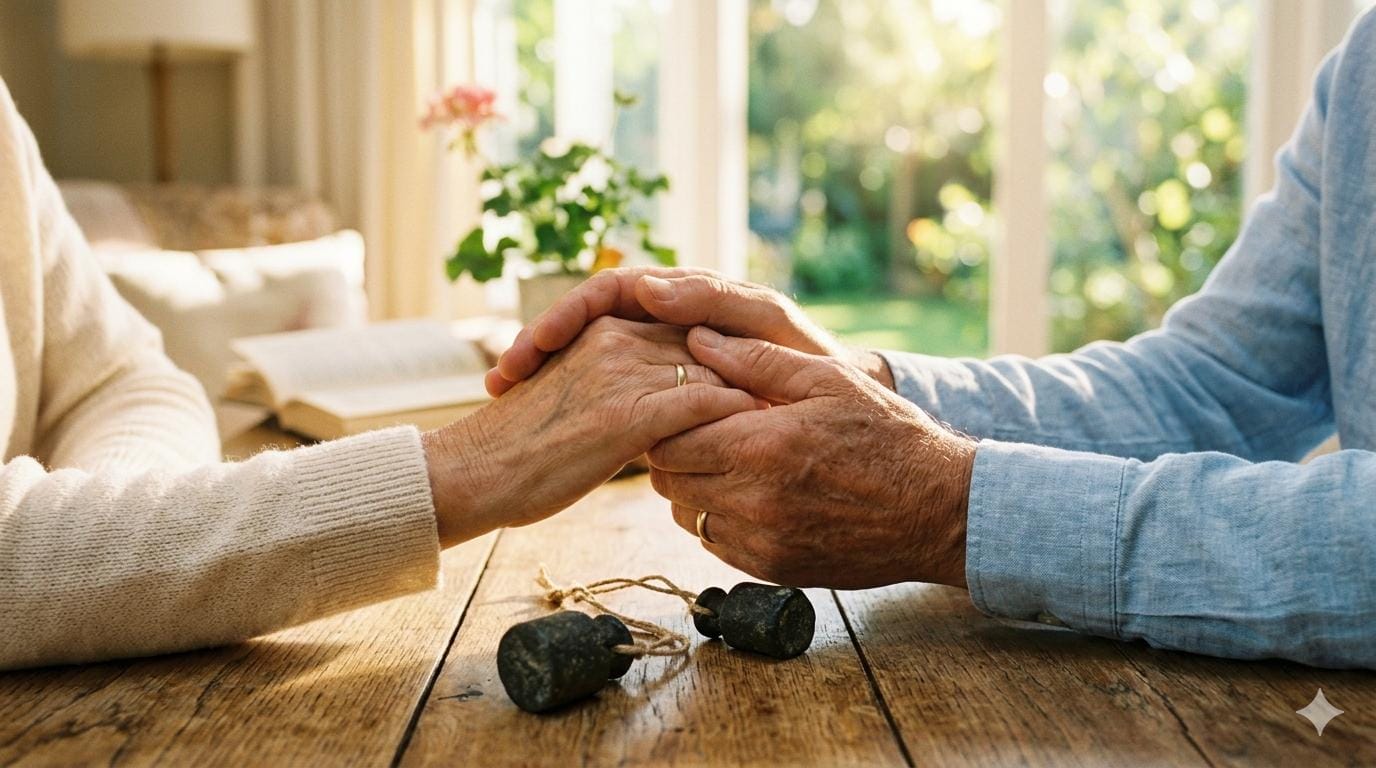
My parents have been married for 50 years. They love each other deeply. But they also fight, carry old grudges, and keep pulling each other back into arguments that should have been buried decades ago. A small slight from years past resurfaces over dinner. An old wound reopens without warning. The love is real, but so is the weight they refuse to put down. And you can see it, in their faces, in their posture, in the tension that fills a room before anyone has said a word.
It makes sense, then, why researchers who studied centenarians found that people who lived past 100 shared one defining trait: they forgave, let go, and refused to carry resentment forward. Held grudges are not just emotional baggage. They are physical ones too.
Most of us do not even realise we are doing it.
We hold the people we love to an impossible standard. We expect our spouse to always understand us, our mother to always say the right thing, our friends to always show up. And when they don't, we feel let down, pull away, and quietly keep score.
But stop for a moment and ask yourself this: if someone graded you on your worst day, the day you were tired, snappy, distracted, or just not present, would you pass your own test?
We rarely turn the lens inward. And that is where the real work begins.
The compounding effect is what makes it dangerous. The more we expect, the more they feel pressured. The more they fall short, the more we withdraw. They expect from us, we fall short too. Round and round, until years of unspoken grudges hollow out a relationship that once felt full of promise.
We accept a C grade in a difficult subject because we know the material was hard. Why don't we extend that same understanding in the most difficult subject of all: human relationships?
Johns Hopkins researchers found that people who simply accepted that no one is perfect were able to rebuild and sustain meaningful relationships, even without an apology from the other person. The Mayo Clinic adds that letting go of grudges leads to lower blood pressure, better mental health, and a stronger immune system. Forgiveness is not something you do for the other person. It is a gift you give yourself.
This is what 50% really means:
It is not half-hearted love. It is not settling for less. It is the honest recognition that even at 100% effort, humans only get it right about half the time. We are wired for blind spots, bad days, and moments of selfishness. So is everyone we love.
Accepting 50% does not mean tolerating cruelty, or abandoning your self-respect, or carrying the relationship entirely on your own. If the effort is always one-sided, that is not a relationship finding its balance. That is one person giving and another taking. But where love genuinely exists on both sides, the effort has a way of evening out over time. One person carries more on some days, the other picks it up on others. That is not weakness. That is how love actually works.
Accepting 50% means choosing the relationship over the scorecard. It means saying: I see your flaws, and I am staying anyway, because I know you see mine too.

My parents have the love. They have always had it. What I wish for them, and honestly for all of us, is the lightness that comes when you finally stop carrying what no longer needs to be carried.
Fifty years is a long time to hold a grudge. But a wonderful amount of time to hold a hand.
It is never too late to let go. And it is never too early to start.